


Our expertise
Events
Tinned food has established itself as one of the safest and most convenient means of preserving food. Today, it remains a mainstay of the global food industry. In this article, we’ll look at why, despite the rise of deep-freezing, modified atmosphere and innovative packaging technologies, cans remain a widely-used standard, and how Steritech autoclaves contribute to this.
Born of the need to preserve foodstuffs for the army over the long term, the tin can is the result of the work of Frenchman Nicolas Appert and Englishman Peter Durand in the early 19th century. Nicolas Appert laid the foundations of appertization, the precursor principle of today’s autoclave heat sterilization processes for foodstuffs. He discovered that heating food in a hermetically sealed glass container could preserve it. Peter Durand subsequently patented the use of tinplate cans, which are more resistant than glass and better suited to the constraints of maritime transport.
In the mid-19th century, French scientist Louis Pasteur proved that micro-organisms can spoil food. His research consolidated the microbiological foundations of pasteurization and sterilization.
At the end of the 19th century, W.L. Underwood (American director of a canned food company) and S.C. Prescott (American scientist) discovered why some cans swelled and exploded despite being heat treated at 100°C. The cause of this deterioration was spore-forming, thermophilic microorganisms. For their shellfish cans, they found that applying pressurized steam at 121°C eliminated bacteria in 10 minutes.
In the early 20th century, W.D. Bigelow, an American scientist specializing in food technology, laid the scientific foundations for calculating industrial sterilization processes. He developed a key method for determining the times and temperatures required to prevent the proliferation of any micro-organisms in canned products.
At the same time, industrial autoclaves were being developed, enabling precise temperature and pressure control, as well as standardization of thermal scales with sterilizing and pasteurizing values, transforming canning into a safe, reproducible process.
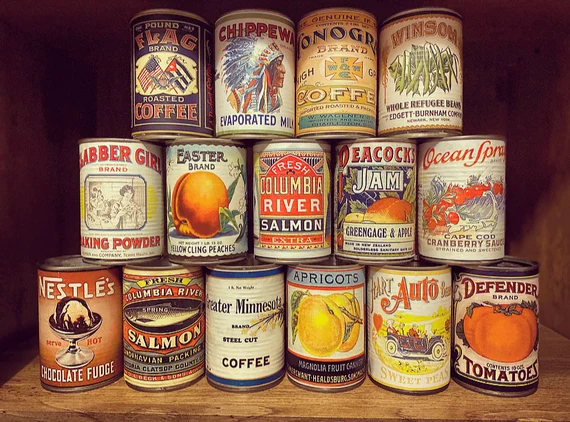
Since its creation, the can has seen its materials evolve towards more sustainable and healthier options. Originally, cans were made from tinplate with a layer of tin to prevent food oxidation. Toxic lead solder was replaced by safer alternatives such as tin soldering or crimping.
As industrialization progressed, thinner rolled steel, still tin-plated, made it possible to manufacture lighter, less expensive cans.
The 20th century saw two major developments:
Today, cans are mainly made of tin-plated steel or aluminum, with BPA-free linings becoming increasingly widespread for health and environmental reasons.
On the other hand, the first cans required a hammer and chisel to open them, and it was in the mid-19th century that the first manual can opener was invented by Ezra Warner, followed by the winding wrench at the end of the 19th century. The tongue-type opener did not appear until the 1960s, thanks to the patented work ofErmal Fraze.
Today, easy-open cans with secure edges are widespread worldwide, and the industry offers various formats (round, rectangular, conical…) adapted to production and consumption needs.
Cans have come a long way, both in terms of materials and opening methods, offering safer, more practical and less operationally costly solutions.

Despite the development of innovative packaging, canned food still offers major advantages :
All these advantages make canning an essential form of packaging in terms of productivity, efficiency and cost control, and help to reduce the canning industry’s carbon footprint.

But what really makes the difference is not the can, it’s the control of the associated heat treatment. And behind each of the above advantages lies a key condition : autoclave sterilization performance.
Steritech autoclaves play a central role in consumer safety and canner reliability thanks to precise temperature and pressure control, mastery of F₀ and P₀ values, heat treatment uniformity and complete cycle traceability via its integrated software solutions, including Trilogy 4.0.
Thanks to Steritech solutions, it is possible to control cycles and recipes in the finest possible way, in order to preserve the colors, flavors and nutritional qualities of food, without the need for preservatives, refrigeration or freezing, for up to several years.
Do you have an autoclave project for your tin cans ? Let’s talk about the Steritech solution best suited to your needs !

